I went into this reading having already seen the movie. Some might not enjoy a book after seeing the film, but I don’t place myself in that category. Seeing the movie first lets me focus on the details and differences within the book without having to imagine the characters and places.
That said, I enjoyed the movie, especially the philosophical and ethical themes in the film, which I think no writer plans, and instead allows to happen. The readers and editors can decide all that later. As with many instances like this, it’s typical to hear that the book is better than the movie, and this book by Cormac McCarthy is not different, so imagine how good the book is when the film is great.
Cormac’s writing style is gritty and clean at the same time. It’s punchy and without punctuation for its dialogue. This style makes the text read smoother, if not as comprehensive, which has novelty to it. It reminds me of another author I’ve read, Mary Karr, who doesn’t use quotation marks in Lit; another pleasant reminder that there are no objective rules in writing. Don’t let English teachers tell you otherwise, especially if they are not also authors.
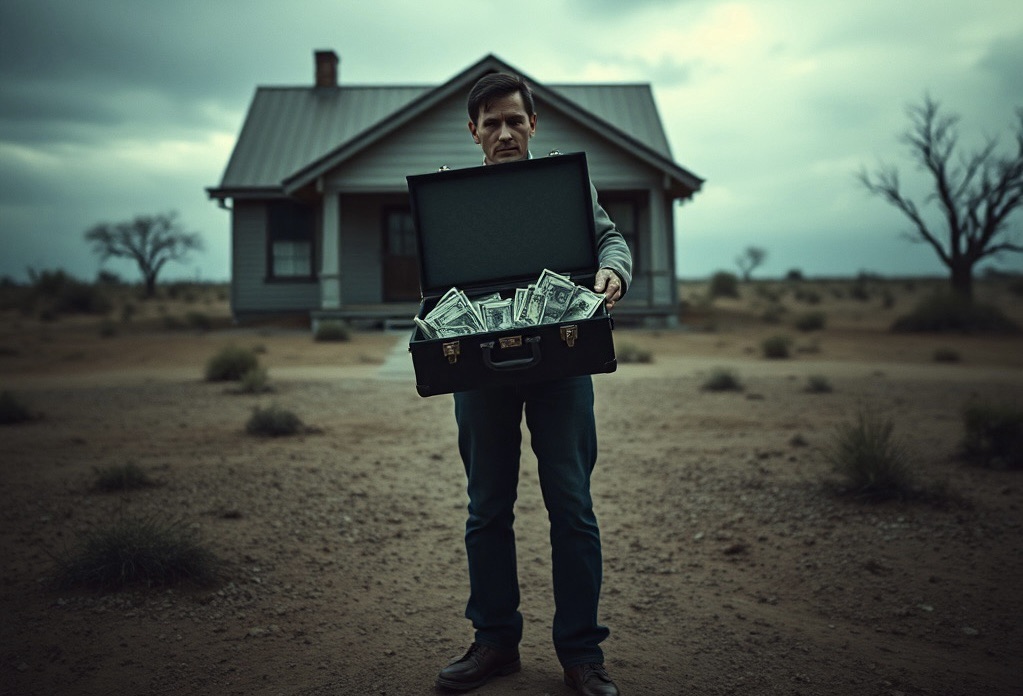
The story follows a few characters: Sheriff Ed Tom Bell, protagonist Llewelyn Moss, and antagonist Anton Chigurh, among a couple lesser others. Without too many spoilers (though there are spoilers presently), Moss finds a satchel with more than 2 million dollars drug money which Chigurh is hired to recover, with Sheriff Bell following the brutal violence that follows every step of the way, comparing such crime to the general quietness of his area of the country. He indicates that underneath the shiny plastic package that is the American dream lies an underbelly of violence, times have gotten worse since his younger days, and impossibly worse compared to the old-timers.
The plot begins as typical hero plots do: Moss is having a normal day hunting in the desert, then his life suddenly changes, taking a violent turn when he finds the money. He comes in close contact with the villain (Chigurh) but gets away, then toward the end, the story turns from the typical hero’s journey to a tragedy. Moss is found dead, murdered not by Chigurh but by killers on the opposite side of the money as Chigurh.
Compared to the movie, it is surprisingly similar, except for a few things, which are covered below. One example is that the film doesn’t mention that Chigurh kills Moss’s wife. Cormac says so directly twice—she was shot, then later, it is noted that she died. The movie isn’t as direct. Chigurh speaks much more in the book than in the film also, which anyone interested in the character’s philosophy will appreciate.
Having Sheriff Bell follow the action afterward offers an outside perspective. My favorite parts are when the words go into italics at the beginning of chapters indicating Sheriff Bell’s internal monologue. He talks about how awful these types (drug dealers, hitmen) are and also that he doesn’t know what to think about it.
One significant mark against the movie is how it leaves out the most crucial aspect of the sheriff’s backstory. Bell confesses to a man named Ellis (who in the movie is his cousin, but in the book, I’m not so sure, maybe his uncle?) about his bronze star. You’d never know about it if you only watched the film.
Major spoilers the sheriff was locked down with his army unit during WWII when a mortar shell hit their position, and the enemy came closer to kill everyone except him. He fled in the night instead of staying and regretted this decision. The sheriff says something along the lines of stealing his own life and that he’s known men who would never in a million years leave that position. They’d instead remain there and kill as many as possible before the end or being saved. Ellis tells him not to be so hard on himself.
Credit to all the actors and actresses in the movie. Were there differences, yes. But not so many that the story changes.
For example, the novel goes slightly deeper in explaining the money Moss finds and the man who hires Carson Wells (played by Woody Harelson). Carson Wells was in special forces, but they don’t mention it in the movie that I remember. The dialogue in the scene where the sheriff meets Moss’s wife and fails to convince her to help him find her husband is different; the screenplay does a better job in this scene, with credit to Tommy Lee Jones. As mentioned before, it is evident in the novel that Chigurh kills Moss’s wife.
Even with such little difference between them, the book is worth a read, even if you’ve seen the film.
Cormac McCarthy’s writing is cutthroat and refreshing in that it doesn’t follow traditional mechanics and delivers information quickly, as if every sentence adds to the story without waste. I enjoyed No Country For Old Men so much that I immediately added another novel by McCarthy called Blood Meridian or The Evening Redness In The West to my library queue. And next, I think I’ll read The Road by the same author, as it’s noted as one of his best works.
I like to find less successful writing from authors I like. Tolstoy is known mostly for War and Peace, but I found his two-volume short fiction at the New York Public Library and got those instead. He writes a lot of military stuff. Anyway, unknown novels by famous authors give reader’s an idea of how not even the greats hit it out of the park every time, either because it was written under a pen name or the author is so prolific that there are plenty of forgotten works in the middle of the pack. That isn’t to say that a less successful work has less merit—on the contrary. To A God Unknown is a lesser known Steinbeck story that’s just as good as Of Mice And Men or The Grapes Of Wrath. My favorite writing by Mark Twain is A Tramp Abroad.
McCarthy has a few I’ll read. Maybe I’ll read all of them.
—KJ
P.S. Dear reader: If you’ve made it this far, I kindly ask you to consider subscribing to my blog and reading one of my novels, too. Writing is a challenging enterprise and your support helps!




 K.J. Maruna
Leave a comment